目录
The Confident Gaze in the Rococo Afterglow: An Appreciation of Marie-Gabrielle Capet’s Self-Portrait
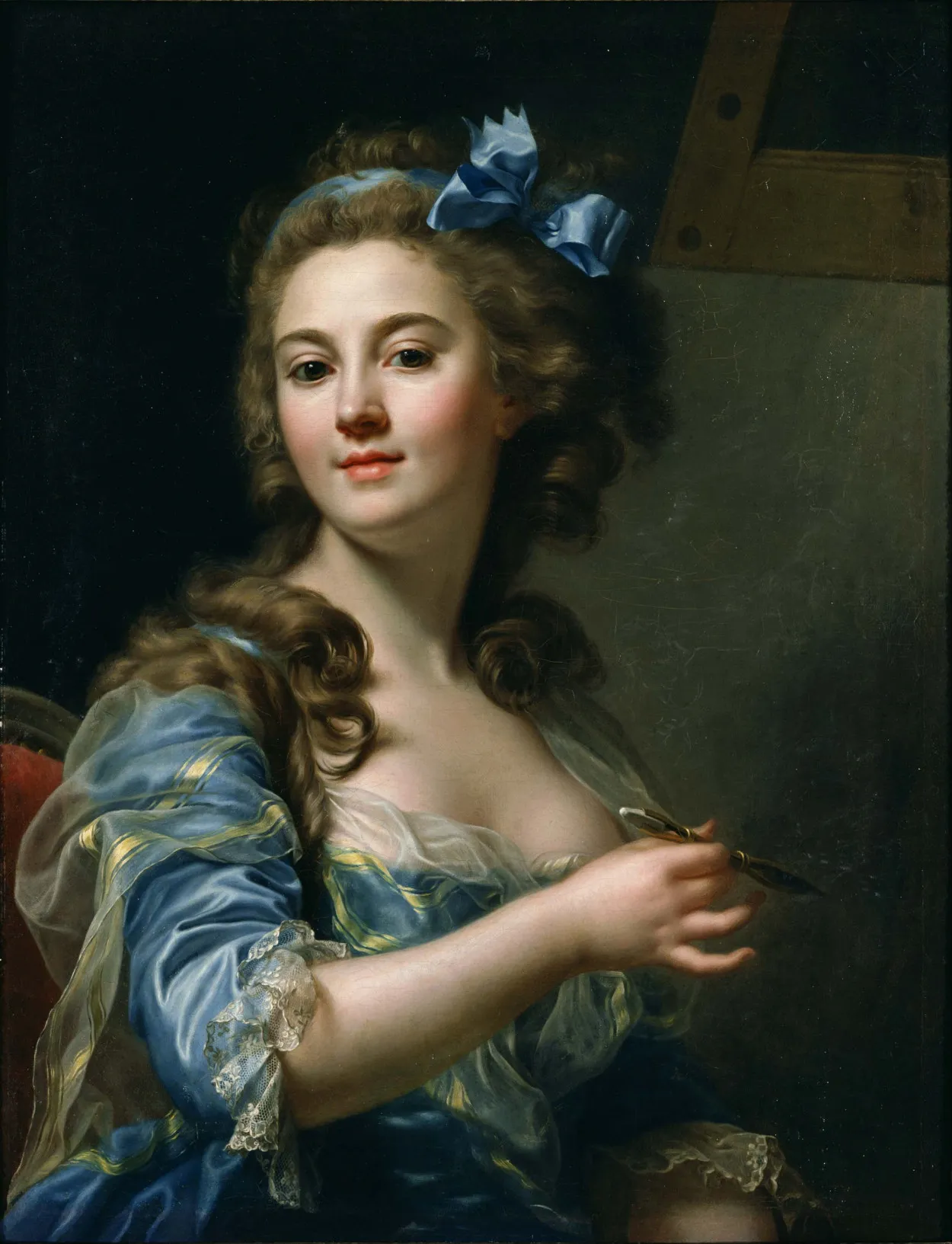
I. Artwork Details
| Item | Details |
|---|---|
| Title | Self-Portrait |
| Artist | Marie-Gabrielle Capet (1761–1818) |
| Date | c. 1783 |
| Medium | Oil on canvas |
| Dimensions | 77.5 × 59.5 cm |
| Collection | The National Museum of Western Art, Tokyo (Acquired in 2001) |
II. The Artist: From a Servant’s Daughter to a Salon Painter
Marie-Gabrielle Capet was born in Lyon, France, in 1761 to parents who worked as domestic servants, an origin of extreme humility. Historical records offer virtually no insight into how she first encountered drawing and painting during childhood, yet it is certain that she demonstrated extraordinary artistic talent from an early age. By the age of nineteen, already an accomplished pastelist, she was able to move to Paris to pursue her artistic aspirations.
In Paris, Capet had the good fortune of becoming a student of Adélaïde Labille-Guiard. Labille-Guiard was one of the few women painters in eighteenth-century France to earn admission into the Académie Royale de Peinture et de Sculpture; in 1783, she was inducted alongside the celebrated Élisabeth Vigée Le Brun—at a time when Academy statutes strictly capped female membership at four. Labille-Guiard was not merely an exceptional painter but also a pioneering mentor dedicated to cultivating female artists, maintaining an atelier that admitted almost exclusively young women.
Capet subsequently became her teacher's most beloved pupil, and the two forged a profound bond akin to that between mother and daughter. Remaining unmarried throughout her life, Capet lived continuously with her mentor and her teacher's husband, the painter François-André Vincent. When Labille-Guiard fell gravely ill in 1803, Capet even temporarily set aside her painting, devoting herself unreservedly to caring for her revered master until her passing.
III. Visual Analysis: A Young Artist’s Declaration of Confidence
1. Composition and Pose
In the painting, the twenty-two-year-old Capet stands poised before an easel, holding drawing chalk fitted into a porte-crayon, her gaze directed toward the viewer with calm and resolute assurance. Her posture is serene and deliberate, as though with the implement in hand, complete mastery is within her grasp.
Notably, faint traces of an underdrawing are visible on the canvas mounted upon the easel—a subtle detail indicating that she is in the midst of the creative act, asserting herself as the active subject of creation rather than a passive object to be beheld. In eighteenth-century portraiture of women, such a self-assured, uncompromising gaze was extraordinarily rare.
2. Color and Attire
Capet is clad in a blue satin gown featuring a bold, fashionable décolletage accented by a matching ribbon bow, its lustrous sheen flowing like water. This luminous hue—later dubbed "Capet blue"—stands out with striking clarity against the somber, dark background, illuminating the sitter as though bathed in a theatrical spotlight.
The blue satin dress and ribbons were the height of contemporary Parisian fashion, exuding the lightness and elegance characteristic of the Rococo style while conveying the distinct air of luxury of eighteenth-century France. Yet the rendering of her attire avoids superficial ostentation: stylish though she appears, her dress never degenerates into mere vanity, serving instead to elevate the character, dignity, and professional presence of the figure.
3. Countenance and Expression
Capet’s complexion is radiant with youth, her eyes luminous and focused, and the corners of her mouth slightly upturned in a quiet curve of self-assurance. The Journal de Paris once praised her as possessing the "surest hand and most accomplished technique among female painters," and this self-portrait serves as the finest visual testament to that acclaim.
IV. Stylistic Context: The Intersection of Rococo and Neoclassicism
Executed in 1783, this work stands precisely at a subtle and critical turning point in French art history.
The afterglow of the Rococo remains distinctly palpable: the shimmering luminosity of the blue satin, the tender, delicate rendering of skin tones, and the overall buoyant, graceful atmosphere all perpetuate the Rococo devotion to sensuous refinement.
At the same time, however, the painting foreshadows the dawn of Neoclassicism: the composition is lucid and direct, the background treated with sober restraint, and the sitter’s expression entirely devoid of theatrical coquetry. This "straightforward, unaffected quality" anticipates the emerging aesthetic ethos that would soon define the era.
At that historical juncture, the tempest of the French Revolution was looming on the horizon. Within the artistic sphere, an idealistic return to classical Greco-Roman antiquity was gathering force, coupled with a newfound realist engagement with the rising bourgeoisie. Capet’s self-portrait captures this transitional moment with consummate nuance—the elegance of the Ancien Régime had not yet faded, even as the sobriety and earnestness of a new era were beginning to emerge.
V. Deeper Significance: The Artistic Self-Awareness of Women
1. From "Subject Painted" to "Practicing Painter"
In eighteenth-century European academic tradition, women were overwhelmingly relegated to the role of subject matter—passive objects to be gazed upon, patronized, and depicted. In this self-portrait, however, Capet presents herself as a creator wielding the tools of her craft, a compositional choice that constitutes a silent yet revolutionary manifesto: she is not an object awaiting admiration, but an artist endowed with full creative agency.
2. A Symbol of Lineage in Women’s Artistic Education
Capet’s emergence exemplifies a precious, rare lineage in the history of women’s art. In 1785, her mentor Labille-Guiard produced the celebrated Self-Portrait with Two Pupils (now in the collection of the Metropolitan Museum of Art, New York), in which the young woman leaning forward in admiration of her teacher's canvas is Capet herself. From the master portraying her student to the student immortalizing herself, this visual dialogue encapsulates the arduous journey of women's art education from systemic exclusion to hard-won institutional recognition.
3. Pioneers on the Public Stage
In 1791, following the onset of the French Revolution, the Paris Salon was opened to all artists for the first time, and Capet was among the twenty-one women painters whose works were accepted for exhibition. Stepping into the public salon halls as an author in her own right, she not only demonstrated consummate technical skill but also claimed vital "visibility" for female practitioners within the public sphere of art.
VI. Viewing Guide: How to "Read" This Painting
- Observe the Gaze: Capet’s gaze toward the viewer is neither obsequious nor haughty, but rather an equal, self-assured stance of dialogue. Try meeting the sitter’s eyes to feel that steadfast resolve echoing across more than two centuries.
- Examine the Hands: Her grip on the chalk holder is natural yet practiced; these are the hands of a working painter—hands of labor and creation, rather than mere decorative appendages.
- Appreciate the Chromatic Contrast: The luminous brilliance of the blue satin dress contrasts sharply with the somber quietude of the dark backdrop. This visual strategy thrusts the figure into prominence while hinting at the painter’s yearning to "be seen" in a male-dominated art world.
- Contextualize within the Era: Imagine Paris in 1783—a mere six years before the storming of the Bastille, with the old order beginning to fracture—as a servant’s daughter boldly proclaims her presence through the power of her brush.
- Compare with Contemporary Works: Consider viewing this painting alongside Labille-Guiard’s Self-Portrait with Two Pupils to appreciate the intimate emotional bond and spiritual lineage connecting these two generations of women artists.
VII. Conclusion
Marie-Gabrielle Capet’s Self-Portrait is far more than an exquisite Rococo likeness. It stands as a testament to singular talent, an epitome of an era’s aesthetic metamorphosis, and a herald of women artists stepping to the forefront of history. As art critics have remarked, the blue gown still shimmers, and the gaze remains ever lucid; yet beyond the confines of the canvas, Capet paved with her brush a path into art history—for herself and for countless women creators to come—not as subjects of another’s narrative, but as the narrators themselves.
本文作者:FitaminD
本文链接:
版权声明:本博客所有文章除特别声明外,均采用 BY-NC-SA 许可协议。转载请注明出处!